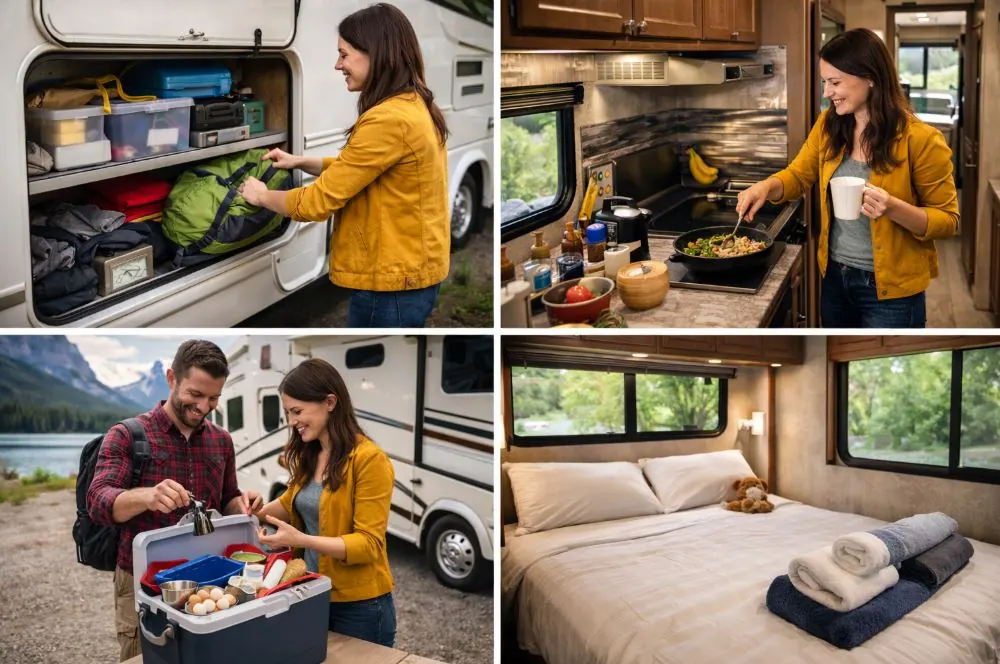
Using a dump station takes about ten minutes once you know the order: put on gloves, connect the sewer hose, drain the black tank first, rinse it, drain the grey tank second, then drain and stow the hose and add toilet chemical. Wait until the tanks are at least two-thirds full so they drain completely, and have everything ready before you pull in so you are not holding up the line.
Know your two tanks
Rental motorhomes in Canada have two waste tanks. As CanaDream's guest guide explains, the grey tank collects water from the kitchen sink, bathroom sink and shower, and the black tank collects waste from the toilet. Each has its own valve handle near the outlet pipe, usually labelled; on many vehicles the black valve is the larger handle.
Watch the monitor panel inside the coach to track levels. Tank sensors can be imprecise, so use the panel as a guide and plan a dump before the tanks are nearly full.
Only empty waste tanks at a proper sani-dump. Do not drain grey water onto the ground: in Banff, Parks Canada asks campers to pour dishwater into outdoor sinks or the campground sani-dump, never into bushes or onto the ground.
When to dump
- When tanks are at least two-thirds full. CanaDream notes that draining works best with fuller tanks, because the volume of liquid pushes solids out.
- Before you run out of options. Plan your next dump station before the tanks fill. If you will not pass one for two or three days and the black tank is not full, add fresh water to bring it to about two-thirds and then dump, so it drains properly.
- At full-hookup sites, keep the valves closed. Let the tanks fill and drain them just before departure. Leaving the black valve open lets liquid run off on its own and can leave solids behind.
- Before returning the vehicle. Check your rental agreement for the condition the tanks must be in at return, and plan a final dump station on the way to the depot.
Step by step at the station
This sequence follows CanaDream's tank draining instructions, with a few practical additions.
Keep a small dump kit together
Store these in the same outside compartment as the sewer hose so nothing has to come through the living area: a box of disposable gloves, a roll of paper towel, a small bottle of hand sanitizer, spare toilet chemical pods and a garbage bag for used gloves. Check at pick-up that the sewer hose, its end fittings and the outlet cap are all present. Our page on what is included with your motorhome rental explains what usually comes with the vehicle.
The routine
- Position the RV. Pull up so your outlet pipe is next to the dump inlet. Check which side of the vehicle your outlet is on before you drive in.
- Put on disposable gloves. Keep a box in the outside compartment with the hose.
- Connect the hose. Take the sewer hose from its storage compartment, remove the cap from the outlet pipe and twist the hose on until it locks.
- Place the other end in the inlet. Push it about 15 to 30 cm (6 to 12 inches) into the dump opening, and weigh it down with your foot, the inlet lid or a rock so it cannot jump out when the flow starts.
- Drain the black tank first. Pull the black valve handle fully open and let it empty.
- Rinse the black tank. Flush the toilet with roughly 5 to 10 litres (1 to 2 gallons) of fresh water to rinse the tank, let it drain, then close the black valve.
- Drain the grey tank. Open the grey valve. The soapy grey water helps flush the hose clean.
- Empty the hose. Close the grey valve, then lift the hose at the RV end and walk it hand over hand toward the inlet to drain it.
- Disconnect and stow. Remove the hose, cap the outlet pipe and store the hose in its compartment.
- Recharge the toilet. Add a toilet chemical pod or packet and about 10 litres of fresh water to the black tank, as directed by your rental company.
Water at the station: potable versus rinse
Many dump stations have two taps. One is drinking water for filling your fresh tank; the other is a rinse hose for the dump area, often marked non-potable. Keep them separate:
- Never use the drinking-water tap or your fresh-water hose to rinse the sewer hose or the ground.
- Never put the rinse hose into your fresh-water tank.
- Fill your fresh tank before you start dumping, or wash your hands and change gloves before you handle the drinking-water hose.
Etiquette at a busy dump station
On summer mornings, campground dump stations get queues as everyone leaves at check-out time. To keep things moving:
- Prepare before you pull in. Have gloves on, the hose out and the toilet chemical ready while you wait.
- Fill fresh water elsewhere if there is a line. Use your campsite tap or a separate fill station if one is available.
- Skip extended rinsing when others are waiting. Do a quick rinse, and save a longer tank flush for a quiet time or a full-hookup site.
- Leave it clean. Rinse any spill into the inlet with the rinse hose and close the lid.
- Avoid the rush. Dumping the evening before you leave, or mid-morning after the first wave, is often faster.
Finding dump stations and avoiding problems
Dump stations are usually found in campgrounds, RV parks, truck stops and some highway rest areas, as Camping and RVing BC notes. Many national park campgrounds in the Rockies list a dumping station among their services. Some stations charge a fee, and some close outside the summer season, so confirm before relying on one.
To avoid clogs and smells:
- Use only RV-approved toilet paper and plenty of water when flushing.
- Never flush wipes, paper towels, tissues, hygiene products or diapers. CanaDream warns that clogs caused by these items are cleared at the guest's expense.
- Keep a little water in the toilet bowl to seal out odours.
- Do not use household drain cleaners in the toilet.
Our campgrounds and RV parks guide explains which types of campgrounds usually offer full hookups.
Bottom line
Black first, grey second, gloves on, and hoses kept separate. Practise once at a quiet station early in the trip and the routine becomes quick. For other pick-up day essentials, read our guide for first-time motorhome renters, and ask us if you want help planning a route with reliable services along the way.
Frequently asked questions
How often will I need to dump the tanks?
It depends on tank size, the number of people and how much you shower on board. Watch the monitor panel and plan your next station before the tanks fill.
Why do I drain the black tank before the grey tank?
The grey tank's soapy water follows the black waste through the hose and rinses it, so the hose is cleaner when you disconnect.
Is it acceptable to empty grey water at my campsite?
No. Waste tanks should only be emptied at a sani-dump or into a sewer connection at a full-hookup site.
Use this guide for trip ideas, not a current quotation or a guarantee of access, safety, inclusions or availability. Confirm the requirements and conditions for your dates, destination and provider before booking.