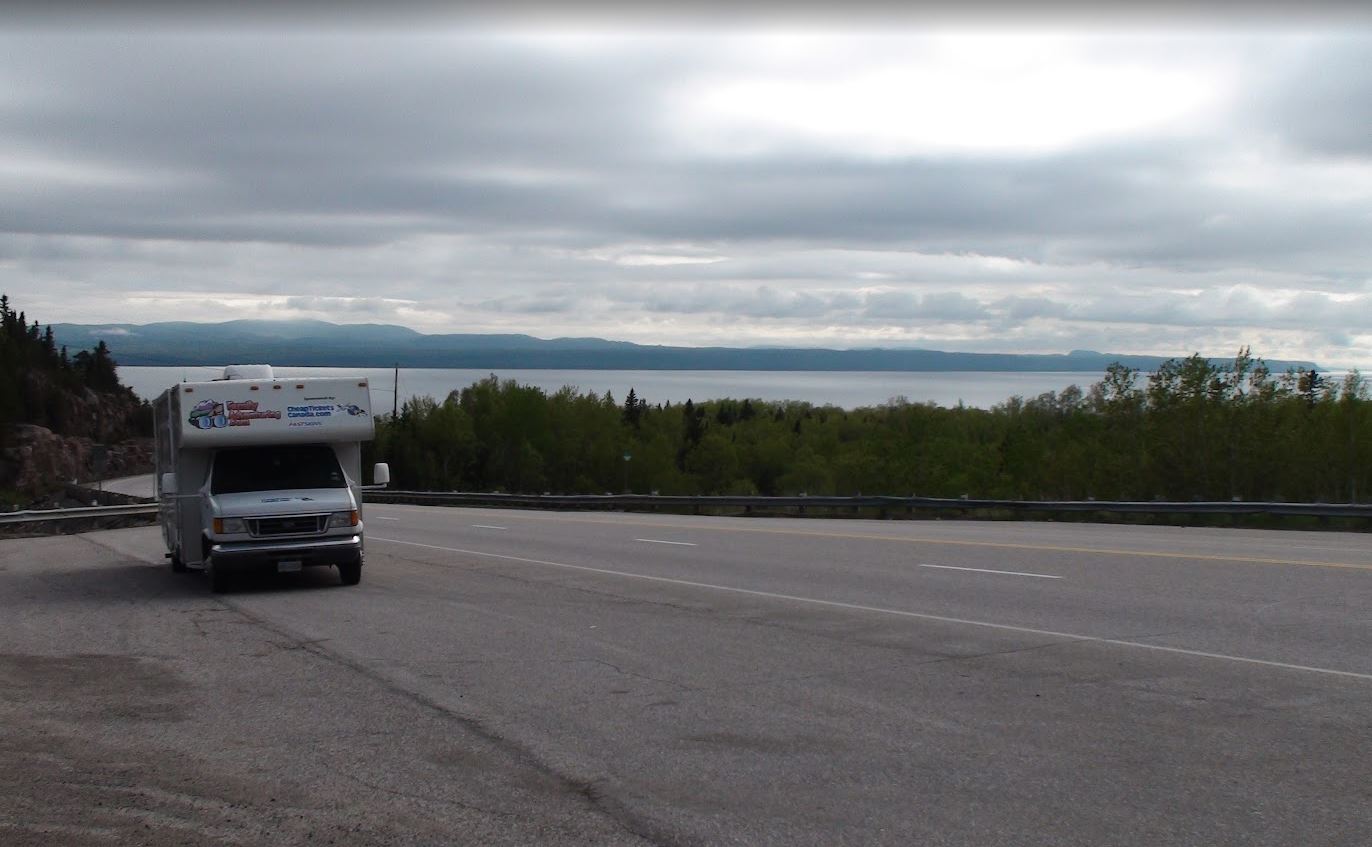
On a long mountain descent, let the engine hold your speed, not the brakes. Engage Tow/Haul or pick a lower gear before the road tips down, choose a speed you can hold without constant braking, and brake in firm, short applications when you need to slow. On climbs, keep right, watch the temperature gauge and pull over at pullouts so traffic behind you can pass.
This guide is for travellers driving rental motorhomes through the passes of British Columbia and the Alberta Rockies. It builds on our general first-time motorhome driving guide.
Why long grades are different in a motorhome
A loaded Class C motorhome weighs several times as much as a car, and all that weight pushes you downhill. Brakes slow you by turning motion into heat. On a short hill they cool before it matters. On a 10 to 20 km descent, steady braking can heat them faster than they can cool, until they "fade" and grip less. CanaDream's driving guidance warns that riding the brakes downhill can burn them out, which is why its RVs have a Tow/Haul function.
The main routes to and through the Rockies cross several high passes. Here are a few that rental motorhomes use often, from the B.C. government's list of summit elevations:
| Pass | Highway | Elevation | Road type |
|---|---|---|---|
| Coquihalla Pass | 5 (north of Hope) | 1,244 m | Four-lane divided |
| Surrey Lake Summit | 5 (north of Merritt) | 1,444 m | Four-lane divided |
| Rogers Pass | 1 (Glacier National Park) | 1,327 m | Two-lane |
| Kicking Horse Pass | 1 (Yoho National Park) | 1,643 m | Two-lane |
| Allison Pass | 3 (Manning Park) | 1,342 m | Two-lane |
| Kootenay Pass | 3 (Salmo to Creston) | 1,774 m | Two-lane |
| Sinclair Pass | 93 (east of Radium) | 1,486 m | Two-lane |
| Vermilion Pass | 93 (Kootenay National Park) | 1,640 m | Two-lane |
The same government page links grade and elevation profiles for many of these highways. They are worth a look before a big driving day.
Engine braking: how to run a descent
Most rental motorhomes in Canada have automatic transmissions on a truck chassis, usually with a Tow/Haul button on the shift lever. In this mode the transmission holds lower gears and downshifts when you brake, so the engine slows the vehicle for you.
- Set up before the crest. Watch for steep-hill warning signs. Engage Tow/Haul and slow down while you are still on the flat or the last of the climb. Keeping a heavy vehicle slow is much easier than slowing it once it has picked up speed.
- Choose a speed you can hold. A useful rule of thumb is to go down no faster than you could climb the same hill. If the speed keeps creeping up with Tow/Haul on, select a lower gear manually. Your depot walk-through should show you how on that model.
- Brake firmly, then release. When you go a little over your target speed, brake firmly enough to drop about 10 km/h, then take your foot off completely. Short, firm applications give the brakes time to cool between uses. Light constant pressure does not.
- Repeat, and drop a gear if braking gets frequent. If you are braking every few seconds, you are in too high a gear.
- Never coast in neutral. The ICBC Learn to Drive Smart guide notes that coasting downhill in neutral is illegal in B.C. It also takes away the engine braking you need.
Your engine will rev higher than usual in low gear. That is expected and is what the transmission is designed for. Stay out of the red zone on the tachometer and you are fine.
Overheating checks on climbs and descents
The engine on long climbs
Climbing at low speed on a warm afternoon makes the engine work hard while less air passes through the radiator. Glance at the temperature gauge every minute or two on a long grade. If it climbs above its usual position:
- Ease off the accelerator and accept a slower speed in a lower gear.
- Switch off the dash air conditioning to take load off the engine.
- If the needle keeps rising, pull fully off at the next safe pullout and let the engine idle to cool. Do not open a hot radiator or coolant cap.
- A warning light or steam means stop and call your rental company's roadside line.
The brakes on long descents
Warning signs of hot brakes include a sharp burning smell, a pedal that feels softer or needs more pressure, and the vehicle not slowing as well as it did at the top. If you notice any of these, slow down with the engine and pull over at the first safe spot. Leave the brakes to cool for a good while before you carry on in a lower gear. Never throw water on hot brakes.
A quick check at the bottom
After a big descent, stop at a rest area and walk around the vehicle. Watch for any smell, smoke or unusual heat from the wheels, and mention anything odd to the rental company before you continue.
Pullout etiquette on two-lane mountain highways
Motorhomes are slower than most traffic uphill. On two-lane roads like Highway 1 through Rogers Pass or Highway 93 through Kootenay National Park, letting others pass is part of driving safely.
- Read the signs. B.C. uses regulatory signs that tell slow vehicles to use pullouts, including one stating that slow traffic delaying five vehicles must use a pullout. The ICBC guide shows these signs. Treat a line of vehicles behind you as your cue, whatever the sign says.
- Use climbing lanes. Where a passing or climbing lane opens, move right and stay there until it ends.
- Signal early and get fully off. Slow down on the road, signal and pull completely clear of the lane. Do not brake hard in the lane.
- Re-enter with patience. A heavy vehicle accelerates slowly uphill, so wait for a long, clear gap.
- Do not stop on the road for wildlife or photos. Use designated pullouts only, and stay in the vehicle near large animals.
- Keep a long following distance downhill. Traffic ahead can slow suddenly at curves, construction or animal sightings.
Weather, season and road reports
Mountain passes can see snow well outside winter, especially at night and early in the morning in spring and autumn. In B.C., winter tires or chains are required on most routes from October 1 to April 30, and a few lower routes end their requirement on March 31. If your rental falls anywhere in that window, ask the rental company in writing whether the vehicle is equipped for designated routes and what it permits.
Before each mountain driving day, check DriveBC for B.C. highways and Alberta 511 for the Alberta side. Look for closures, construction delays, wildfire smoke and pass conditions. Our travel tips and safety advice page covers what to carry for remote stretches with patchy cell coverage.
A simple pre-pass routine
- Check the road report and weather for the summit, not just the towns on each side.
- Fill the fuel tank. Climbing burns noticeably more fuel.
- Stow loose items and latch cupboards and the fridge door. Steep grades and sharp curves will throw anything unsecured.
- Plan the drive in daylight with time in hand, so you never feel rushed into a descent.
- Agree on a pullout plan with your co-driver: who watches the mirrors and who calls out the next pullout.
Bottom line
Gear down before the descent, brake in short firm bursts, watch the temperature gauge on the climbs and pull over whenever traffic stacks up behind you. Do that, and the passes become the best part of the drive. If you are still choosing a route, our Rockies route guide compares options by trip length, and we can help you plan the driving days around the big grades.
Frequently asked questions
Is the Coquihalla harder than Highway 1 in a motorhome?
The Coquihalla is a four-lane divided highway, so passing is easier, but its long grades still call for engine braking. Highway 1 through Rogers and Kicking Horse passes is mostly two-lane, so pullout etiquette matters more.
Should I use cruise control on mountain highways?
Turn it off on steep or winding sections and in rain or snow, so you control your speed and gear directly.
Use this guide for trip ideas, not a current quotation or a guarantee of access, safety, inclusions or availability. Confirm the requirements and conditions for your dates, destination and provider before booking.